
Different QuEChERS methods
QuEChERS
QuEChERS (Quick, Easy, Cheap, Effective, Rugged and Safe) is a highly efficient sample preparation technique for the analysis of pestide residues and trace contaminants in different types of sample matrices. This method reduces solvent consumption, sample preparation time and cost, making it an attractive alternative to traditional techniques such as Soxhlet or ultrasonic extraction.
There are two main steps when using QuEChERS: extraction and cleanup. Before extraction can begin for solid samples with little to no water content, water must be added as appropriate for the sample size. Sample extraction involves using a solvent and salt mixture to separate the target analytes by moving them into the organic phase whilst minimising matrix effects.
Dispersive solid phase extraction (d-SPE) cleanup aims to remove any matrix interferences such as sugars and pigments from the sample extract achieving a sample ready for analysis, for injection into the gas chromatograph (GC) or high performance liquid chromatograph (HPLC)
Over time, several standardized and modified versions of the QuEChERS method have been developed to suit different sample types and matrices.
Official standard QuEChERS Methods
There are three widely used QuEChERS methods which are selected based on your sample type. These are the original unbuffered method and then the two buffered methods, the AOAC method and European EN method.
The original unbuffered method is a fast and easy multiresidue method employing acetonitrile extraction and d-SPE for the determination of pesticide residues.
AOAC 2007.01 method is commonly used for the analysis of pesticide residues in foods using acetonitrile extraction and partitioning with magnesium sulphate.
The European EN 15662 method is ideal for foods derived from plants to be analysed by MS for the determination of pesticide residues. This method comprises of an acetonitrile extraction with a d-SPE clean up.
Choosing between buffered and unbuffered salts should be determined by the pH of the final extract and how pH sensitive the target analytes are. If target analytes are unstable in a certain pH range then by using buffered extraction salts will maintain the ideal pH, ensuring more accurate results. When analysing pH sensitive pesticides (e.g. captan, chlorothalonil, pymetrozine and antrazine) the buffered methods help control the pH during the extraction steps optimizing the recovery of acid and base-sensitive pesticides.
Table 1 Buffered QuEChERS methods
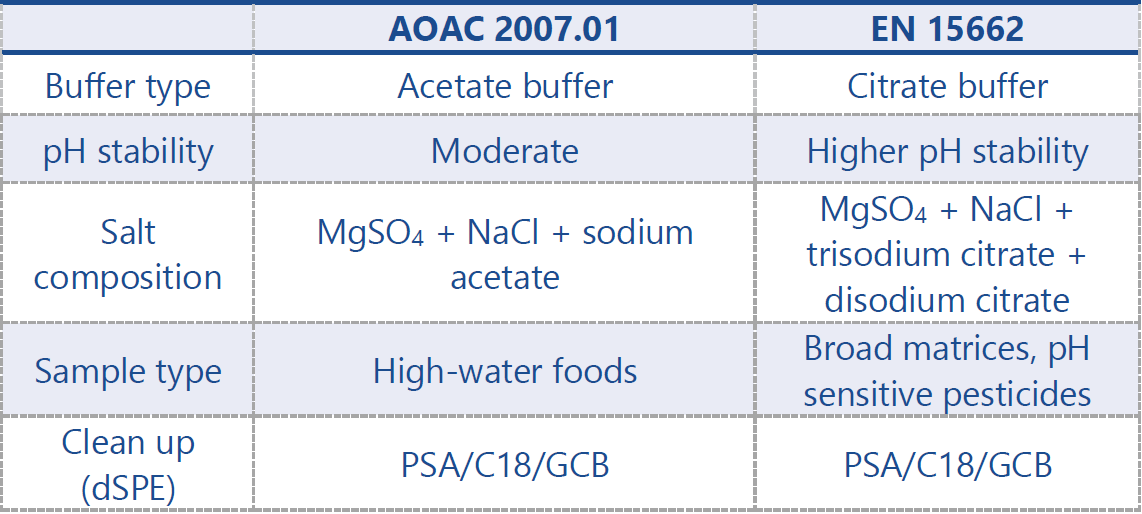
AOAC salts buffer the final extract to a pH of around 4.75 so a more acidic pH. EN salts buffer the final extract to 5.0-5.5 which is more neutral than AOAC. When using unbuffered salt the pH of the final extract is based on the sample pH.
Importance of clean-up contents
Small polypropylene centrifuge tubes are pre-filled with precise weights and proportions of bulk drying salts and SPE sorbent packings to remove excess water and unwanted contaminants from the sample extracts.
There are different d-SPE clean up tubes available which vary in their contents. Selection of the clean-up tube is dependent on the sample matrix. See examples below:
- Primary Secondary Amine (PSA) removes organic acids, sugars and fatty acids, which is best for samples with high sugar content or acids such as fruits and juices.
- Octadecylsilane (C18) adsorbs fats and lipids, which is best for samples with fats such as dairy, meat and oily products.
- Graphitized Carbon Black (GCB) removes strong coloured pigments, which is best for samples with high pigments such as leafy vegetables, spices and tea.
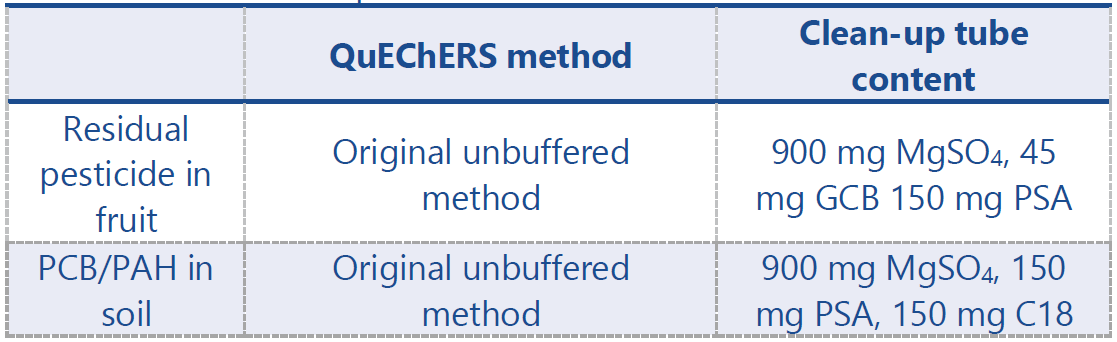
The choice of the correct composition in the clean-up tube (Table 2). When the wrong composition is chosen this can affect the recovery of compounds and the results of the sample can be unreliable.
Table 2 Different clean up content
PCB/PAH in soil QuEChERS method
The following method describes how QuEChERS can be used in the extraction of PAH/PCB compounds from soil samples.
To prepare the samples, weigh in 5 grams of soil in 50 mL tube, add 15 mL of acetonitrile/water (75%:25%, v/v). Vortex this mixture for 4 minutes and ultrasonicate for 20 minutes. Add extraction salts (4 g MgSO4 and 1 g NaCl) and vortex for 4 minutes. Centrifuge for 10 minutes at 400 rpm. Transfer 6 mL of the supernatant to a 15 mL tube with clean up containing 900 mg MgSO4, 150 mg Primary Secondary Amine (PSA), 150 mg Octadecylsilane (C18). Vortex for 4 minutes and centrifuge for 10 minutes at 4500 rpm. 1.5 mL of the upper layer is filtered directly
into the vial, ready for analysis.
To increase reliability of your results you can use spiked samples and an internal standard. For example, QC samples (n=6) are spiked with the PCB/PAH standard and the internal standard and samples (n=3) are spiked with the internal standard only prior to the sample preparation with QuEChERS. The recovery is calculated using the QC samples. The internal standard takes into account the variability between injections. See our technical note on internal standards in the knowledge centre.
Reactions
| Reaction | Figure |
|---|---|
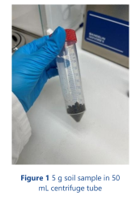
| 1. Soil + Acetonitrile/Water (75%/25,% v/v)
In this step the acetonitrile extracts the PCBs and PAHs from the soil matrix. The acetonitrile solubilizes nonpolar and moderately polar organics like PCBs and PAHs. Water helps to disrupt soil aggregates. |
 |
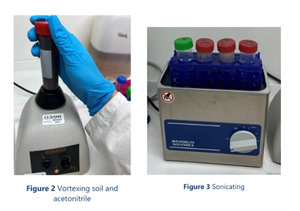
| 2. Vortexing and sonication
This will enhance the extraction efficiency. The vortex will cause the soil to breakdown and mix with the solution. The sonicator disrupts the soil structure and releasing the analytes. Overall this will improve the transfer of the PCB/PAHs into the solvent. |
 |
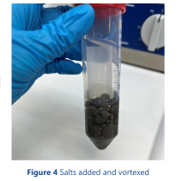
| 3. Addition of extraction salts
The exothermic reaction between MgSO4 and water will create a new crystalline hydrate structure. MgSO4 (s) + H2O (l) → MgSO4 . H2O (s) The addition of NaCl results in salting-out due to the solution increasing in ionic strength, forcing the PCBs and PAHs to move to the acetonitrile organic layer. |
 |
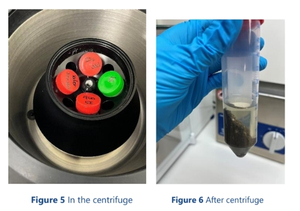
| 4. Centrifuge
The phases will separate in the centrifuge and three layers will appear. The acetonitrile organic layer (supernatant), a salt aqueous layer and a solid soil salt layer. |
 |
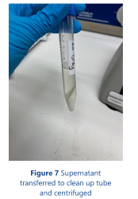
| 5. Cleanup
The addition of MgSO4 will cause a reaction seen in Step 3 and dry the extract. The PSA will remove humic acids, fatty acids and phenol acids. C18 removes non-polar matrix components. |
 |
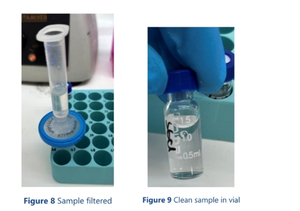
| 6. Final centrifugation and filtration
The centrifugation will separate the liquid extract from the solid sorbents. Filtration removes remaining unwanted particles. |
 |