
Analysis of VOCs in Environmental Samples using EPA Method 8260
Why test for VOCs in environmental samples?
Volatile organic compounds (VOCs) are a group of chemicals, e.g. xylene, which readily volatilize at low temperatures from certain liquids and solids.1 VOCs can be released from an extensive number of sources as organic chemicals and are used in a wide variety of everyday products such as paints, fuels and household cleaners. VOCs are known to lead to both short term and long term health effects from eye, nose and throat irritation to causing damage to kidneys, liver and the central nervous
system.2
VOC sampling
The sample matrix and target analytes will determine how the samples are collected, preserved and stored. See our technical note on Environmental samples from air, soil and water for more information.
When sampling VOCs it is integral that you minimize the loss of these compounds when sampling and when conducting any sample preparation. If samples aren’t treated appropriately then this can cause the loss of VOCs and in turn lead to false negatives. Many regulated methods will require QC samples to be carried out to ensure target analytes are not lost or affected during any sample preparation or analysis. See our technical note on Quality Control Best Practice for more information.
Headspace is a sample preparation technique which can be used to extract VOCs from both solid and liquid matrices without the need for extensive sample preparation.
EPA method 5021A
Method 5021A: “Volatile organic compounds in various sample matrices using equilibrium headspace analysis” gives guidance on the preparation of VOCs for headspace sampling.1 This method specifically discusses soil/ sediment, solid waste, aqueous and water miscible samples preparation for static headspace sampling to be analyzed by gas chromatography (GC) or gas chromatography-mass spectroscopy (GC-MS).
This method describes the use of matrix modifiers and chemical preservatives in samples. Matrix modifiers are used to increase response and improve reproducibility of VOCs being sampled from the headspace vial by adding a soluble salt solution to the samples prior to headspace sampling. By adding this salt solution it aids VOCs going into the headspace from the aqueous phase and decreases discrepancies between samples due to aqueous activity.
Chemical preservatives may be necessary to alter the pH of your sample in order to protect the sample against degradation before analysis. The chemical preservative will be dependant on the target VOCs and the sample matrix. These preservatives are added before sealing of the sample vial prior to analysis. For more information on EPA Method 5021A see our technical note on Headspace Sampling for VOCs using EPA Method 5021A.
EPA method 8260
EPA Method 8260 is a versatile method for the determination of VOC content in a variety of sample matrices such as water and soil by gas chromatography-mass spectrometry (GC-MS). A large number of VOCs have been outlined in this method with guidance on appropriate sampling techniques, sample preparation and analysis of these compounds. In this method it states that headspace may be used for the introduction of VOCs from aqueous and solid samples into a GCMS system with guidance from EPA Method 5021.3
EPA method 8260 specifies the acceptable criteria for the system precision results and recovery of target analytes. The precision results is specified as an RSD (%) ≤20% and the suggested acceptance criteria for the recovery of the target analytes is 70- 130%.3
Recoveries are calculated from the results of analyzed QC spiked samples. Spiking the sample allows the performance of the analytical method to be evaluated to ensure that the method produces accurate and valid results. By spiking your sample you increase the concentration of the target analytes by a known amount and therefore will be able to determine if the added analytes are recovered. It is key to spike your sample at a concentration within your linearity range and sample volume is not increased. This allows calculations to be consistent and avoids introducing unknown effects. See our technical note on Recovery Spiked Sample for more information.
SCION Instruments validated a method for VOC analysis in water samples with guidance from EPA method 8260 using the SCION Instruments Versa headspace sampler combined with the SCION 8300 GC and SQ 8700 MS. The Versa is a static headspace sampler so data was acquired using a loop method. The results were then compared to results collected using the SCION Instruments Versa headspace sampler with the SCION 8300 GC-FID in both water and soil samples.
VOCs in water samples by HS-GC-MS
Table 1 shows an example of results from QC spiked water samples (n=6) collected for VOC compounds analysed by HS-GC-MS using the Versa headspace sampler.
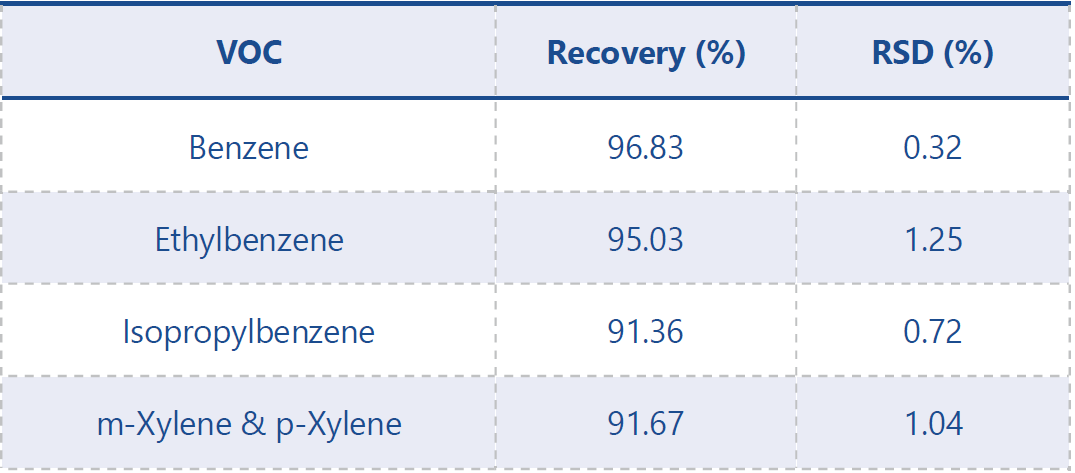
Table 1. Average recovery and precision results from QC spiked water samples using Versa-GC-MS @30 ppb
In this application a linearity range of 1, 5, 10, 30 and 100 ppb was analyzed across several VOC compounds obtained from a commercially available standard. The system showed excellent specificity with compounds resolving well from one another and exhibiting good peak shape.
All linearity, QC and water samples contained 100 ppb of the internal standard (IS) fluorobenzene which was used to help improve precision of results. For more information on Internal Standards, see our technical note. To improve system sensitivity, Selective Ion Monitoring (SIM) was employed. Each VOC had a single quantifier ion and two qualifier ions selected to avoid false identification.
For instrument parameters, sample preparation and method validation for this application, see our application note AN189 Analysis of Volatile Organic Compounds (VOCs) in Water using HS-GC-MS (Versa): EPA Method 8260.
The results for VOC analysis in water samples with guidance from EPA method 8260 using the Versa headspace sampler were then compared with results from our HT3 headspace sampler in static mode with the SCION 8300 GC and SQ 8700 MS. See our application note AN191 Analysis of Volatile Organic Compounds (VOCs) in Water using HS-GC-MS with EPA Method 8260: Versa vs HT3 Static.
The HT3 headspace sampler can also be configured for dynamic headspace sampling using a trap method. For a comparison of results between the HT3 in static and dynamic mode, see our application note AN188 Analysis of Volatile Organic Compounds (VOCs) in Water using HS-GC-MS with EPA method 8260: Static vs Dynamic Headspace.
VOCs in water and soil samples by HS-GC-FID
Table 2 shows an example of results from QC spiked water samples (n=6) collected for VOC compounds analysed by HSGC- FID using the Versa headspace sampler.
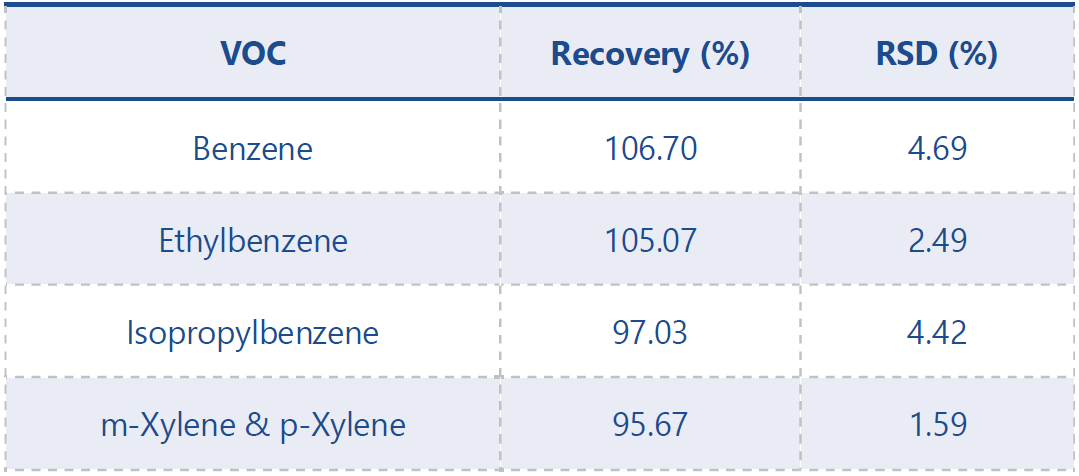
Table 2. Recovery and precision results from QC spiked water samples using Versa- GC-FID @ 30 ppb
Table 3 shows an example of results from QC spiked soil samples (n=5) collected for VOC compounds analysed by HS-GC-FID using the Versa headspace sampler.
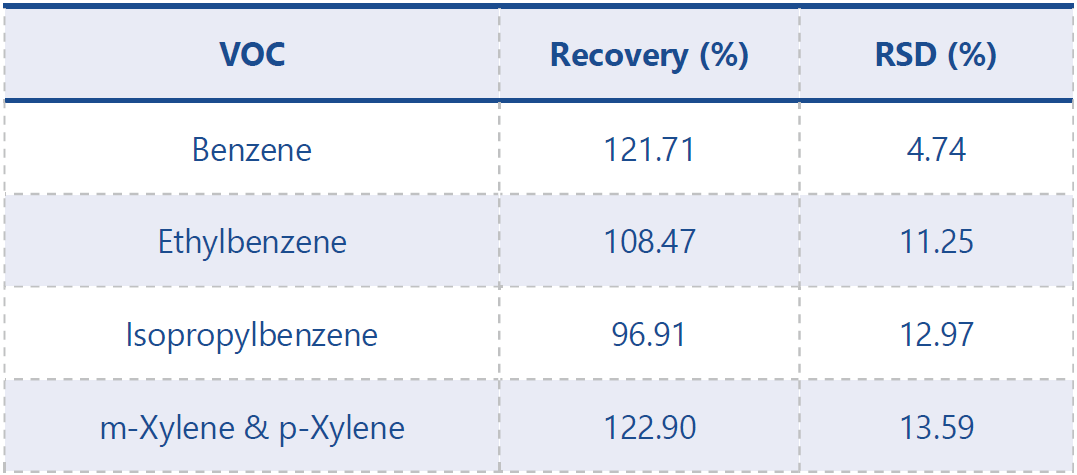
Table 3. Recovery and precision results from QC spiked soil samples using Versa-GC-FID @ 30 ppb
A single point calibration was used for the quantitative analysis of samples analyzed using the HS-GC-FID. A single point calibration assumes a linear relationship and is the simplest form of calibration. All samples contained 100 ppb of IS. For the comparison of water samples analyzed for VOCs by HSGC- FID and HS-GC-MS, see our application note AN192 Analysis of Volatile Organic Compounds (VOCs) in Water using EPA Method 8260: Versa-GC-MS vs Versa-GC-FID.
References
1. United States Environmental Protection Agency, https://www.epa.gov/east-palestine-oh-train-derailment/whatare-svocs-and-vocs, (accessed Feb 2026).
2. United States Environmental Protection Agency, https://www.epa.gov/indoor-air-quality-iaq/volatile-organiccompounds-impact-indoor-air-quality#Health_Effects, (accessed Feb 2026).
3. United States Environmental Protection Agency, https://www.epa.gov/esam/epa-method-8260d-sw-846-volatile-organic-compounds-gas-chromatography-massspectrometry-gcms, (date accessed Feb 2026).