
Simultaneous Screening and Targeted Analysis: Full Scan and SIM in a Single MSWS Method
What is Full Scan?
Full Scan captures all the ions in a set mass range outlined by the user. Full Scan will produce a Total Ion Chromatogram (TIC) for the chosen mass range. The peaks in this chromatogram can be selected to view their corresponding mass spectra. This mass spectra can be compared against known compounds in a mass spectral library i.e. NIST to identify the compound. This scan mode is extremely useful for identifying new or unknown compounds and allows for qualitative analysis.
What is SIM?
Selected Ion Monitoring (SIM) differs from Full Scan as it only searches for specific ions at certain retention times. Due to the selective nature of this scan type it gives a higher sensitivity and a lower noise result. A SIM method would be used when you have known compounds and therefore know their retention time and masses. This scan type is more suitable for quantitative analysis.
In SIM mode quantifier and qualifier ions are selected to prevent false positives and increase the reliability of your results. A quantifier ion is usually the most abundant ion in your mass spectra then you would select multiple qualifier ions i.e. 2nd and 3rd most abundant ions. See Figure 1 for an example of 4-Isopropyltoluene showing the quantifier and qualifier ions.
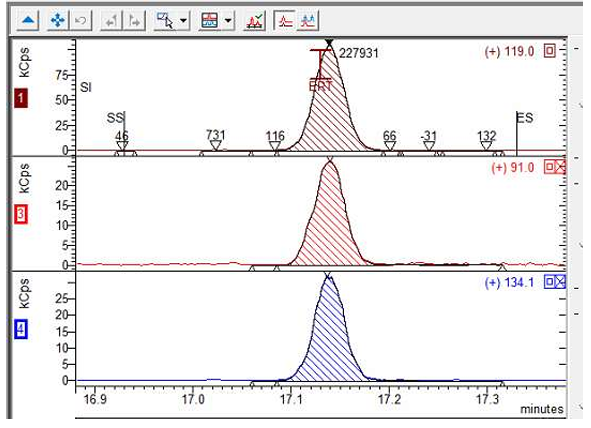 Figure 1 Example of 4-Isopropyltoluene showing quantifier (top) and qualifier plots (middle and bottom).
Full Scan and SIM in a single method
In our Mass Spectrometer (MS) software, MSWS, you have the ability to run both a Full Scan and SIM method simultaneously in a single method. This means that the MS will use both scan modes during the same run. See Figure 2 for an example of an acquisition method from MSWS showing both Full Scan and SIM in one method.
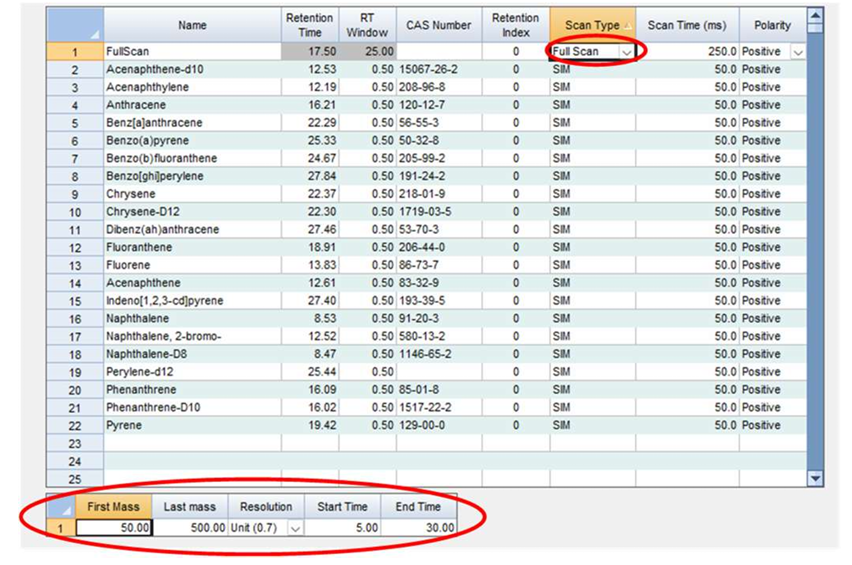 Figure 2 Showing Acquisition Method from MSWS Method Editor with both Full scan and SIM within one method
From Figure 2, the circled areas highlight the Full Scan conditions, the Full Scan will run from 5 to 30 minutes and scan for masses 50 to 500. Simultaneously the MS will scan at certain retention time windows for particular compounds e.g. Naphthalene at 8.53 minutes (±0.50 minutes) for 50 ms.
The cycle time and dwell time should be optimized to ensure that the data points for both modes are accurate. Different retention time windows can be used to prioritize SIM during elution periods that include critical compounds.
In Figure 3, the compound graph from MSWS can be seen. This is a visual representation of a single method which contains both Full Scan and SIM. The greyed area represents the collection delay which was set to 5 minutes in the method to avoid capturing the solvent peak in the analysis. Point 1 starts at 5 minutes and has a scan time of 250 ms. The SIM windows start from Point 2 at 8.20 minutes and scans for 0.5 minutes looking for Naphthalene and Naphthalene-D8. Due to the MS scanning in both Full Scan and SIM at Point 2, the total scan time has increased to 300 ms (250 ms Full Scan + 50 ms SIM).
In MSWS, the method can be set to report any unknown peaks in your analysis but to then automatically search a selected mass spectral library to try to identify the unknown compound. The results can then be reviewed by the analyst to determine the likelihood of the match being correct. See our technical note in SCION’s knowledge centre on NIST library compound scoring GC-MS for more information on how to determine the probability of the library match to your unknown compound being accurate. See Figure 4 for an example of a library search for an unknown compound which results show is likely to be Cashmeran.
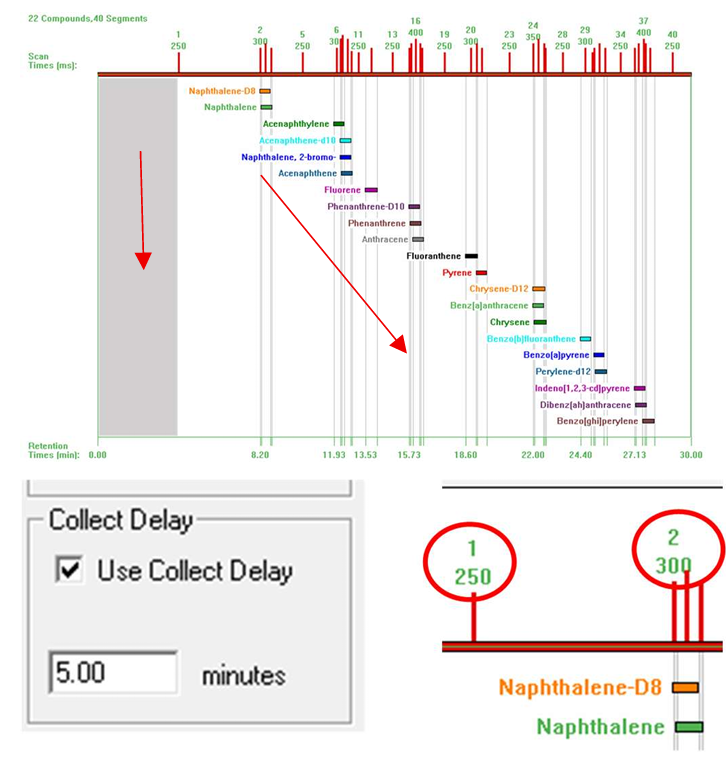 Figure 3 Showing Compound Graph from MSWS Method Editor with both Full scan and SIM within one method. The greyed section at 0-5 min represents the collection delay.
Advantages and disadvantages of Full Scan and SIM in one method
The main advantage of having a single method which performs both Full Scan and SIM simultaneously is that you only need to run your analysis once to see results for both scan types. This will reduce total time needed for analysis and less sample volume will be required.
The main disadvantage to using a single method containing both scan types is that since the MS is scanning in both modes this will cause some of loss in sensitivity.
For a novice user this method could be challenging as you will have two data sets both Full Scan and SIM therefore the data processing required as a result of this method may be more suitable for an advanced user.
Applications using Full Scan and SIM simultaneously
Screening, profiling and targeted analysis being conducted simultaneously can be useful for applications such as fragrances analysis. When analysing a fragrance you may need to look for certain compounds such as allergens but also want to know the fragrance profile of the product.
Targeted analysis for specific compounds such as the IFRA 57 allergens may be required as part of regulatory testing. IFRA 57 is a list of 57 specific suspected fragrance allergens which must be below 2 mg/kg to be deemed as safe to the consumer and the environment. Whilst fragrance screening can allow the analyst to use a generic method to screen for a wide range of products and to identify unknown compounds such a undesired impurities. Fragrance profiling can be used to define a fragrance product’s unique sensory fingerprint and be used to reverse engineer existing products and develop new products.
Being able to use Full Scan and SIM in a single method allows the analyst to perform a general screening and targeted analysis at the same time. For more information on fragrances analysis using MSWS see our application notes AN186 IFRA 57 Allergens in Fragrance Materials using GC-MS with Hydrogen Carrier Gas and AN187 Fragrance Screening and Profiling using GC-MS equipped with FFNSC Library on the SCION Instruments website.
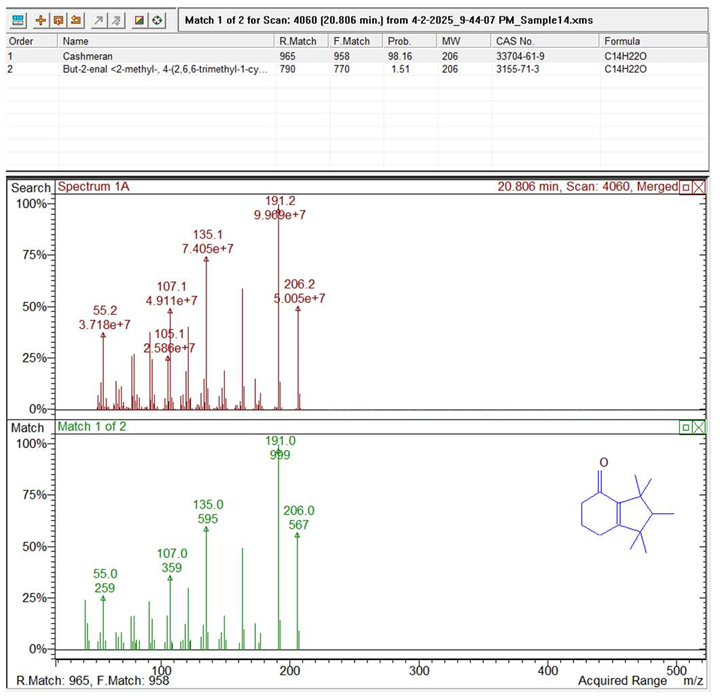 Figure 4 Library search results for unknown peak at 20.81 min