
Screening for unknowns using GC-MS
When a sample contains unknown compounds, the best place to start is with a general GC-MS method. This method should include a slow oven ramp with a long hold at the end, this will ensure that all of the sample is eluted from the column. Then for the first injection run a blank, this should only contain the solvent. Now the scan time can be adjusted, the scan time should start after the solvent peak to reduce source contamination. Ensure that the scan range is large enough to detect the compounds that are of interest. A good starting point for this is usually
around 40 to 500.
Fullscan captures a wide range of ions and is especially useful for unknown compounds and qualitative analysis. Fullscan will give a Total Ion Chromatogram (TIC), this results in that each peak having a spectrum (Figure 1).
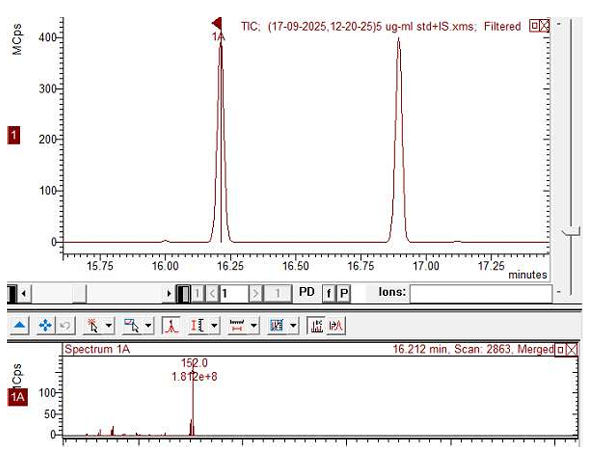
Figure 1 Mass spectrum in TIC
Selected Ion Monitoring (SIM) will only search for specific ions, it is more suitable for the quantification of known compounds and can be employed for continued analysis once the impurities have been identified. Fullscan and SIM can be used simultaneously but this will cause some of loss in sensitivity.
If the mass spectrometer is used simultaneously with Fullscan and SIM, the MS will switch between SIM and Fullscan during the run. The cycle time and dwell time should be optimized to ensure that the data points for both modes are accurate. Different retention time windows can be used to prioritize SIM during elution periods that include critical compounds.
National Institute of Standards and Technology (NIST) library
The NIST* library will examine the peaks in the chromatogram. The NIST library works as follows; open the chromatogram in the software (MSWS), then click on the peak of interest in the chromatogram, click on the NIST button on top of the data review tab. The NIST library will now open and search for corresponding mass spectra. An example is shown below (Figure 2) from compound acenaphthylene. The red spectrum is from the sample run on the MS and the blue is from acenaphthylene from the NIST library.
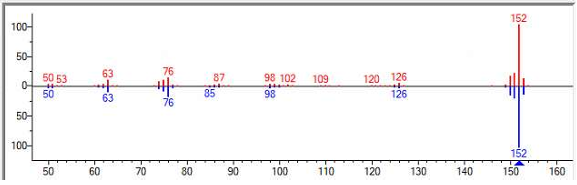
Figure 2 NIST mass spectrum comparison
A list of different compounds will be displayed and they are ranked based on how well their reference mass spectra matches the unknown spectrum. The compound with the highest spectrum similarity is at top of the list and deemed most likely to be the correct identification of the unknown compound. In this case that is correct (Figure 3). For help interpreting library spectra matches see our guide NIST library compound scoring.
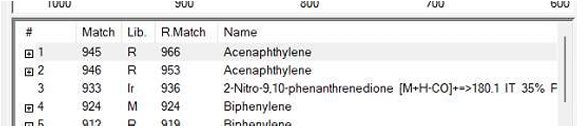
Figure 3 list of matches
Depending on the column being used and the compounds that are of interest, there could be peaks which coelute. In order to identify these peaks it may be necessary to change column to one of a different polarity i.e. from SCION-5MS to SCION624MS. The separation will look different on the second column, which can mean that previously co-eluting peaks are now separated and can be detected individually.
If there is still uncertainty over if this correct compound has been identified then an analytical standard should be purchased and injected onto the GC-MS. Our Application Note AN165: “Plant Protection Product Impurity Screening by GC-FID with GC-MS confirmation” explains how to determine unknown impurities using the MS, FID and analytical standards and can be found on the SCION Instruments website.
*Disclaimer: NIST must be purchased separately it is not included with MSWS.