
A basic guide to mid-point backflush
What is backflush and why is it used?
Certain sample matrices contain heavy components which could have negative effects on sensitive GC parts and the analysis overall. For example, detectors such as a MS, are vulnerable to heavy component contamination because they can cause deposition on the ion source, lenses and quadrupole leading to increased background and sensitivity loss.
Furthermore, heavy components can spend a long time on the column leading to carry over, longer run times and extra bake out time. To avoid frequent downtime for column maintenance and detector cleaning it would be preferable if these heavy components never reached these sensitive parts of the GC. To achieve this a backflush is used in which the flow of the carrier gas is reversed after a predetermined time to push the heavy components back towards the inlet and out of the spilt valve.
What are the requirements and how does it work?
To use a backflush a GC system requires some extra hardware to allow the carrier flow to be reversed. First, an extra column is added (pre-column) with either the same or different dimensions and stationary phase. Between these two columns a microfluidic splitter is installed which is connected to its own electronic flow controller (EFC) which ultimately allows the reversal of the flow.
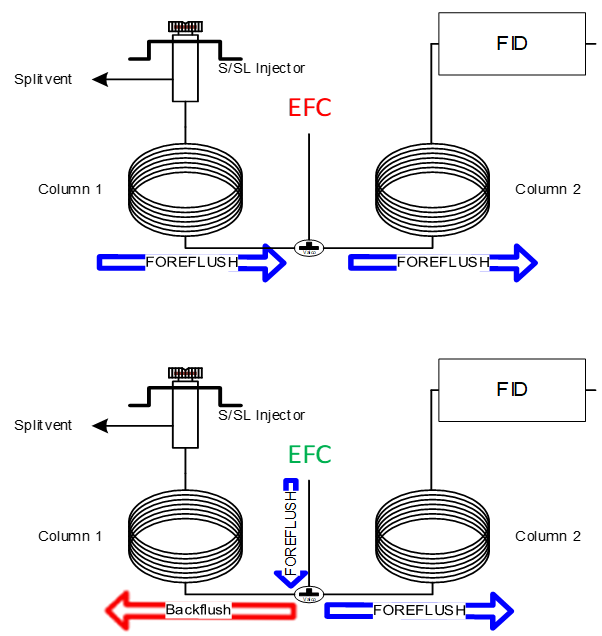
Figure 1. Backflush system in off (top) and on (bottom) position
Figure 1 shows the same GC in both the off and on configuration for the backflush. When the backflush is not engaged the inlet is the source of the carrier gas in the GC. Once the backflush is engaged the pressure in the inlet is turned off and the EFC takes over continuing to drive the analyte through the second column towards the detector but pushing the heavy components back towards the split vent in the inlet.
How to determine backflush time?
Once the required hardware is installed a new GC method can be created. Along with normal optimization the backflush time must also be determined. This is done by identifying the retention time of the last eluting compound of interest. It is important to tune the backflush time to engage after the last compound of interest has passed the valve.
If the backflush is started before it will be backflushed out of the system. If the backflush is started too late then not all the heavy contaminants will be flushed out of the system. It is important to allow sufficient time to pass for all contaminants to backflush out of the system before starting a new analysis. To ensure that the heavy contaminants are backflushed completely the GC should run in the backflush configuration for the same or more time as the fore flush.
Benefits of backflush
Using backflush reduces run time because the heavy components do not have to travel across the analytical column and are instead pushed back and vented. Furthermore, these components will not reach sensitive parts of the GC like the analytical column and detector.
Drawbacks of backflush
When using a backflush, method optimisation will take longer due to needing to optimise the backflush times. This is to ensure a time is selected that allows all compounds of interest to be detected but all heavy contaminants are flushed out of the system.
Adding a backflush to your system introduces new gas connections. Each extra connection introduced to a GC is another potential point of failure i.e. a leak. When adding an additional capability to your GC, the maintenance it requires must also be tracked and conducted to keep your system operational and working effectively.
What maintenance does a backflush require?
Backflush requires some additional maintenance. The EFC needs to be pressure tested to ensure the right flows are reached. The split vent trap will need to be replaced more often due to the heavy matrix flowing back through the inlet. All connections need to be leak checked regularly to ensure optimal GC performance.