
Programmable Temperature Vaporizing (PTV) Injector Guide
What is a PTV injector?
A PTV injector is similar to a Split/Splitless (SSL) injector as it is capable of operating in both split and splitless modes but it can be programmed for isothermal or variable temperature operations. It is compatible with a range of open tubular capillary columns and can be used for large volume injections (LVI). Learn more about SCION’s injectors in our Injectors Guide.
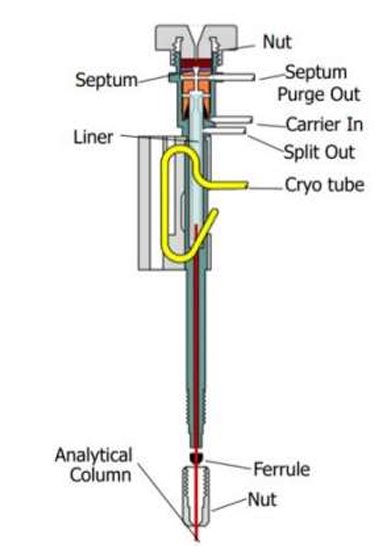 Figure 1 Diagram of PTV injector
How does a PTV injector work?
A PTV injector has the ability to do split and splitless injections as well as pulsed injections. This gives great versatility within the injection program to allow samples with a wide range of concentrations to be analysed. Pulsed injections are beneficial for trace analysis.
The PTV can be programmed within the instrument method to ramp the temperature of the injector or it can be used isothermally. The temperature range of the injector is from near ambient to 450 °C. The PTV injector also has the option to be cryogenically cooled to -160 °C. The cooling option can help with the efficiency of cooling between injections or for low temperature injections. Depending on the type of analysis,
cooling can be done through air, LN2 and LCO2.
The advantage of using a temperature programme is that it allows compounds with a range of boiling points in the same mixture to be analysed. The programme can start at a lower temperature to protect compounds which would be degraded by higher temperatures but then the temperature can be ramped to ensure everything in the sample is volatized effectively in the injector.
Large Volume Injections (LVI) of 5-250 μL can be facilitated on the PTV injector. This type of injection is used where the absolute lowest level of detection is required. The sample is deposited onto the injector slowly and the solvent is vented and the analytes are transferred onto the column.
PTV Liners
A PTV injector can be used for applications such as hydrocarbon analysis and the analysis of fatty acids. It is crucial to select the correct liner for the application. It is important to note that the liner and solvent choice as well as the method temperature and injection volume are key to successful analysis and avoiding issues such as backflash in the injector. Some examples of liners which can be used in a PTV injector are shown in Figure 2.
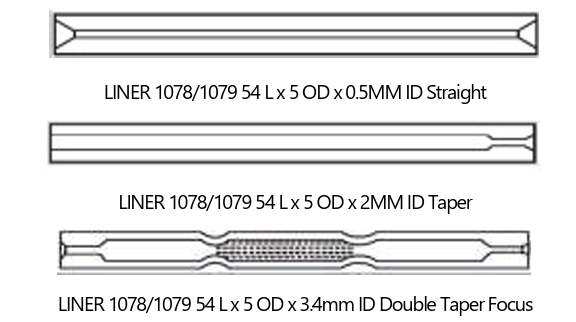 Figure 2 PTV injector liner examples
PTV Maintenance
It is recommended to have a maintenance schedule for your instruments. The frequency of maintenance will be dependant of the applications being conducted and the sample matrix.
Before any maintenance is performed, cool the injector and then turn off gases. Always wear gloves and work in a clean workspace to prevent contamination. The consumables which should be changed on a regular basis are the septa, liner and Oring.
Annual maintenance should include the changing of the split filters but this should be completed as part of a yearly service by a service engineer. There are two split filters, the charcoal and moisture filter.
The maintenance which can be carried out on a PTV is similar to that of an SSL injector. See our SSL maintenance guide in the SCION knowledge centre for more information.