More Efficient Sample Preparation: Reducing Solvent Use, Saving Time and Money
There are many benefits to trying to reduce sample and solvent volumes used within your lab. Some of these benefits include cost, health and waste. There are alternative sample preparation techniques now widely available which can allow your lab to become more efficient, reduce sample preparation time and decrease the need for costly solvents and laboratory glassware and equipment.
Vial Inserts
To significantly reduce the amount of sample or standard which needs to be added to a sample vial for a successful injection, a vial insert can be used. Vial inserts go inside your sample vials and are usually made from glass or plastic. They come in a variety of sizes and can be flat bottomed, conical or come with feet.
Each vial insert type has advantages and disadvantages. Flat bottom inserts can be used for larger volume samples or when it is not critical to withdraw the complete sample. Conical inserts are more suited for small volume samples but can be more difficult for manual pipetting. Spring-loaded inserts (or ones with feet) prevent the insert from moving in the vial, so there is consistent sample positioning but they are more expensive and caution needs to be taken to not dislodge the spring. Depending on your lab sample preparation techniques, sample types and instrument set up, will determine which vial inserts are most suitable for your application.
The benefit of reducing volumes needed for sample vials is the possible reduction in volume of solvent and analytical standards used in sample preparation e.g. for a linearity preparation. See Figure 1 which shows two different prepared linearities. One linearity is prepared in 10 mL volumetric flasks whilst the other is prepared in 1.5 mL microcentrifuge tubes. Minimising solvent and standards being consumed will lead to reduced cost and waste.
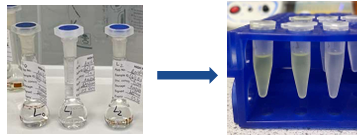
Figure 1 Linearity preparation scaled down to reduce solvent use
Weighing Small Masses
When planning your sample preparation a limiting factor could be your ability to weigh small masses on your analytical balance. Techcomp includes SCION Instruments but also Precisa. The Precisa Series 390 Analytical Balance HF model has a readability of 0.1 mg and a key feature of this balance is it’s integrated ECS (Electrostatic Cancellation System) which neutralizes all electrostatic charges inside the draft shield to ensure an accurate weighing. This allows gloves to be worn when weighing which is beneficial if working with hazardous samples.
The ability to confidently weigh masses down to 0.1 mg allows samples to be prepared on a smaller scale which will use less sample, less solvents and analytical standards.
Sample Preparation Techniques
Reducing the volume of solvents and the scale of preparation of standards and samples is beneficial but there are other sample preparation techniques which could be used as an alternative method.
Headspace is a popular sample preparation technique which can be used to extract volatile compounds from a sample with minimal sample preparation. This is done by heating your sample which causes target analytes to move into the gas headspace of the vial. This versatile technique allows samples which would not be suitable for direct injection into the GC or require extensive sample preparation to become suitable to be analysed.
Solid Phase Microextraction (SPME) is a solvent free sample preparation technique which can extract target analytes from a sample by either headspace or direct immersion depending on the application. The SPME fibre or arrow concentrates the semi volatile or volatile target analytes via adsorption or absorption.
QuEChERS (Quick, Easy, Cheap, Effective, Rugged and Safe) is a type of solid phase extraction which can be used for a variety of samples and target analytes. QuEChERS isolates target analytes and reduces sample matrix effects. They can be used as an alternative to traditional techniques such as Soxhlet Extraction. Compared to traditional techniques QuEChERS save time, use minimal solvents and don’t require specific laboratory glassware or extraction systems
Where the sample preparation technique cannot be switched to an alternative method then changing the solvent used could be an option. Changing the solvent used in your sample preparation could have health and environmental advantages and reduce cost.
For more information on sample preparation technique selection and on the techniques themselves, see our Technical Notes in the SCION knowledge centre on our website.